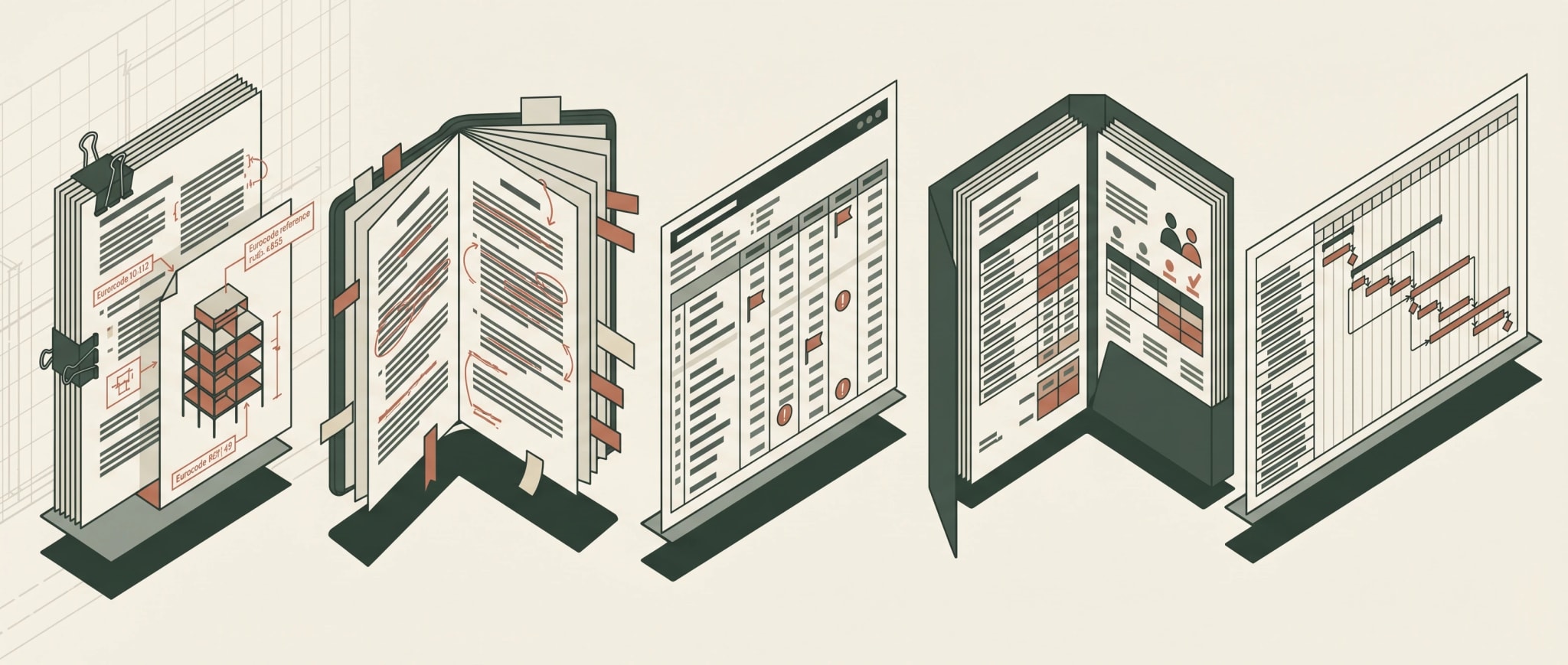
The Marketplace covers the common patterns. For everything else — your firm’s protocol, an unusual edge case, a one-off forensic — you type the brief. The agent decomposes, dispatches, returns.
Scroll to advance
Vonbuild · Live Session
Programme the steel framing delivery for Lot 03 and verify it fits the May 12 RDC casting window.
Type a request or pick from the Marketplace…
Or type your own request
No matching workflow? Just ask.
Scroll to advance
Vonbuild · Live Session
Programme the steel framing delivery for Lot 03 and verify it fits the May 12 RDC casting window.
Type a request or pick from the Marketplace…
The tasks senior people lose weeks to
Vonbuild can
build a claim file from 400 documents.detect bid-rigging across 24 months.generate a 200-page calculation note.recover a 3-months-late project.respond to a 600-page RFP.brief a new engineer in 2 hours.defend against a delay claim.capture a retiring senior's methods.build a claim file from 400 documents.
8 of 99,999+ deep AEC tasks. Not "summarize this." Not "draft an email." The work that used to require 3 weeks of senior time. Build your own workflow in 20 minutes. Use the Marketplace for the rest.
What it costs. What you get back.
A 15-person firm. The math, without anything hidden.
What you invest
200 CHF × 15 users × 12 months
= 36,000 CHF / year
Includes all 5 departments, unlimited projects, unlimited document ingestion, Claude + GPT + Gemini, browser automation, 27 MCP integrations.
What you recover
~200 hours / person / year of production time
× 55 CHF/h loaded cost × 15 people
= ~170,000 CHF / year
Conservative estimate. Part3 2025 benchmark documents 480–600 hours achievable per person on document coordination alone.
~5x
First-year return
~11 weeks
Payback
50K CHF+
Cost of one missed deadline
The product · 5 departments of senior-level workforce
Each department does the work you used to assign to your senior people.
Not assistants. Not chatbots. Each one is a factory of specialized AI workers that handles the deep, multi-week tasks your firm has historically outsourced to lawyers, expert engineers, claims consultants. Any department can take the lead depending on the task. See the full architecture →
Sales, PM, legal, procurement — every department syncs its folder to the same project. The graph keeps growing as people work: timeline, entities, documents, decisions. Join today, you inherit everything that came before. Leave tomorrow, your trace stays. Sensitive entities stay invisible to those without clearance — the agent decides who sees what.
Projects
Search projects
Create project
TMFR
Tour Mirabeau
Active · 47 conv.
HLFR
Hospital Lyon
Active · 23 conv.
BMDE
Berlin Mitte Tower
Active · 89 conv.
GLCH
Geneva Léman Center
Inactive · 12 conv.
LBUK
London Bridge Phase 2
Inactive · 34 conv.
RMFIDIC
Riyadh Metro Lot 4
Inactive · 156 conv.
1Project choice
2Project info
3OneDrive folders
What changes in your week
Same project. Same people. Different workflow.
Today
3 days. 3 meetings. 15 emails.
A structural modification arrives. You need the engineering impact, the cost delta, the contractual eligibility, the procurement consequences, and the planning slip. You coordinate between 5 departments over email. The full picture lands on your desk Thursday. The forfeiture notification deadline is Friday.
With Vonbuild
20 minutes. One note. One click.
The same modification triggers the 5 departments simultaneously. 20 minutes later, the consolidated impact note is on your screen — engineering, cost, contracts, procurement, planning — with the notification letter already drafted. You validate with one click. It's Tuesday afternoon. You move on.
Live process · Cascade
One signal. Five masters. One decision.
From a single revised drawing on OneDrive to a fully reconciled, evidence-backed decision in your hands. Three minutes. Zero meetings.
Scroll to advance
01
Signal
14:32 — a revised structural drawing lands in OneDrive.
The structural engineer uploads rev 3.2 of the plan for beam P-12. The section changed from B22 to B25. Nobody emails you. Nobody schedules a meeting. The system detects the event and wakes up.
Source: OneDrive · rev_3.2_structure_beam-P12.pdf
02
Routing
The system reads the drawing. Identifies 5 impacts. Dispatches.
The plan change affects structural loads, cost estimation, material procurement, contract eligibility, and project planning. Each department receives its specific sub-task — automatically. No human decided who should work on what. No email chain. 312 milliseconds.
5 departments activated · 312 ms · 0 human input
03
5 departments. In parallel.
Each one produces a concrete deliverable.
Sales recalculates the bill of quantities. Operations updates the Gantt and finds the slip. Procurement flags the steel order to re-consult. Engineering runs the EC3 verification inside Robot. Legal checks amendment eligibility and drafts the notification letter. Five outputs. Three minutes. All sourced.
Critical-path tasks T-12 (formwork) and T-15 (pour) impacted
planning-rev3-delta.gantt
MASTER
Procurement
Reorder
PO-23-447 — S355 steel lot LV-3, 3 suppliers to reconsult
procurement-impact-rev3.md
MASTER
Engineering
EC3 ✓
Beam P-12 section B25 verified, utilization 68%
calc-poutre-P12.report.pdf
MASTER
Legal
VC-024
Variation eligible — CCAP Art 9.2, notification by May 19
avenant-rev3-draft.docx
5 deliverables produced · all traceable · all sourced
04
Convergence
5 analyses. One impact note. Ready to validate.
The outputs converge into a single cross-domain impact note: +18% structural loads on foundation FF-3 · +€48,300 total (gros œuvre + fondations) · Amendment eligible under CCAP Art 9.2 — 15-day notification window · +11 working days on critical path · Steel lot LV-3 must be reordered. Every line is sourced. Every document is linked. Every number is traceable to the agent that produced it and the tool that computed it.
1 consolidated impact note · 5 evidence chains
05
Validation
You open your laptop. The analysis is already done.
Three minutes after the drawing landed in OneDrive, the complete cross-domain impact note is waiting for you. Engineering verified. Cost recalculated. Contract eligibility checked. Planning updated. Notification letter drafted. You read the summary. Check the evidence links. Click Approve. The notification letter goes out. The timeline logs the decision. The procurement agent starts the reorder process.
3 minutes · signal to decision · 45 seconds of human time
06
7 days later. No human involved.
Tuesday, May 13. You forgot about this. The system didn't.
During the original analysis, the Sales department noticed the subcontractor had not acknowledged the variation claim. It scheduled a follow-up: check acknowledgement in 7 days. Seven days pass. You are on a different project, a different floor, a different problem. At 09:00 on May 13, the system wakes itself up. It checks whether an acknowledgement email has arrived. It has not. The agent drafts a follow-up letter, attaches the original claim reference, and submits it for your approval. You did not set a reminder. You did not write a post-it. The system remembered because that is what it does.
T+3minT+7 DAYS LATER · auto-fired
Auto-fired · T+7 days · 0 human reminders · 0 missed deadlines
Live demo · Browser automation
The agent runs your calculation software. You get the certified result.
The agent opens Robot Structural Analysis in its own browser, inputs the parameters, runs the calculation, and extracts the certified result. The professional tool produces the number. The agent orchestrates. The output carries the same legal weight as if your engineer had clicked through the software manually.
Master Technical pilots a certified engineering tool — autonomously
No approximation · the certified tool computes · the agent extracts
Upload your entire project folder. Within minutes, every clause is linked to its penalty, every invoice to its BOQ line, every decision to its responsible party. Ask any question across the full corpus. Get a sourced answer with document and page references.
Determinism
Certified tools produce the numbers. Not the AI.
When you need a Eurocode check, the agent opens your professional software in its own browser, runs the calculation, and extracts the certified result. The tool produces the number. The agent orchestrates. Traceable, auditable, reproducible.
Proactivity
They prepare overnight. You validate over coffee.
An email arrives at 11pm with a revised plan. By morning, the impact is analyzed, the affected trades are flagged, the notification letter is drafted — waiting for your read and your one-click validation. They schedule their own follow-ups. Nothing binding leaves without you.
Extensions
When a senior leaves, their methods stay.
An Extension is a reusable script, workflow, or normative calculation your team builds once and the agents reuse forever. Your firm's review checklist. The Eurocode 3 verification your senior engineer wrote. The tender comparison protocol that catches gaps. Procedural memory that compounds. Available in the internal Marketplace.
Inside the app · Marketplace
Where every Extension lives.
Industry standards, your firm's protocols, auto-generated mini-apps — one searchable library. DSI governance gates promotion. Every user picks up where the senior left off.
HubSpot CRM — deals, contacts, pipeline sync for the Sales tower.
0 / 26 workspaces
The agents prepare. You decide.
Autonomous doesn't mean unsupervised. Every irreversible action passes through you. Your existing security policies stay enforced.
Human-in-the-loop
Supervised autonomy
An agent can analyze 10,000 documents alone. It cannot send a single binding email without your approval. Every action with financial, legal, or contractual impact is blocked until you validate. The AI prepares the evidence. You take the decision.
Audit trail
Every action logged
Each record carries: user, timestamp, action, model version, document hash, source citations, and approval chain. Immutable. Exportable as JSON for legal discovery or internal audit.
Your governance
Your identity, your rules
Vonbuild operates inside your existing Microsoft 365 or Google Workspace tenant. Your access policies, conditional access rules, DLP boundaries, and compliance perimeters carry over automatically. No new security model to validate with IT.Security architecture →
Mathieu, suite à notre échange, je confirme que la livraison de la charpente acier prévue le 8 mai accuse un retard de 12 jours. Nous demandons une mise à jour du planning d'ici vendredi.
Live demo · Human-in-the-loop
This is what "you decide" looks like.
Every binding action — external email, contract send, payment authorization — blocks for your explicit click. The AI prepares the evidence; the decision is yours. Your signature still stands. Liability stays human.
Independent benchmarks
The numbers the industry confirms
Independent benchmarks from 450+ architecture and engineering firms in Europe and the US. The CFO doesn't need to take our word for it.
34%
of an architect's time goes to non-billable tasks — coordination, admin, document search.
Monograph 2025 Benchmark
480–600h
recoverable per person per year with a 20–25% efficiency gain on document coordination alone.
Part3 Administration Study 2025
3–5%
overbilling routinely found on construction invoicing — recoverable through line-by-line cross-referencing.
Industry consensus, multiple benchmarks
Try it on a real project. See the ROI yourself.
A single missed forfeiture deadline costs more than a year of Vonbuild. The question isn't whether you can afford it — it's whether you can afford not to know what your agents would have caught.
Upload your most complex project. See what happens.
Pick the folder with the most documents, the tightest deadlines, the messiest coordination. That's where the difference shows. 15-day pilot. Real project. Real results.